About Moka pots
How and why I moved on from imitations to a Bialetti.
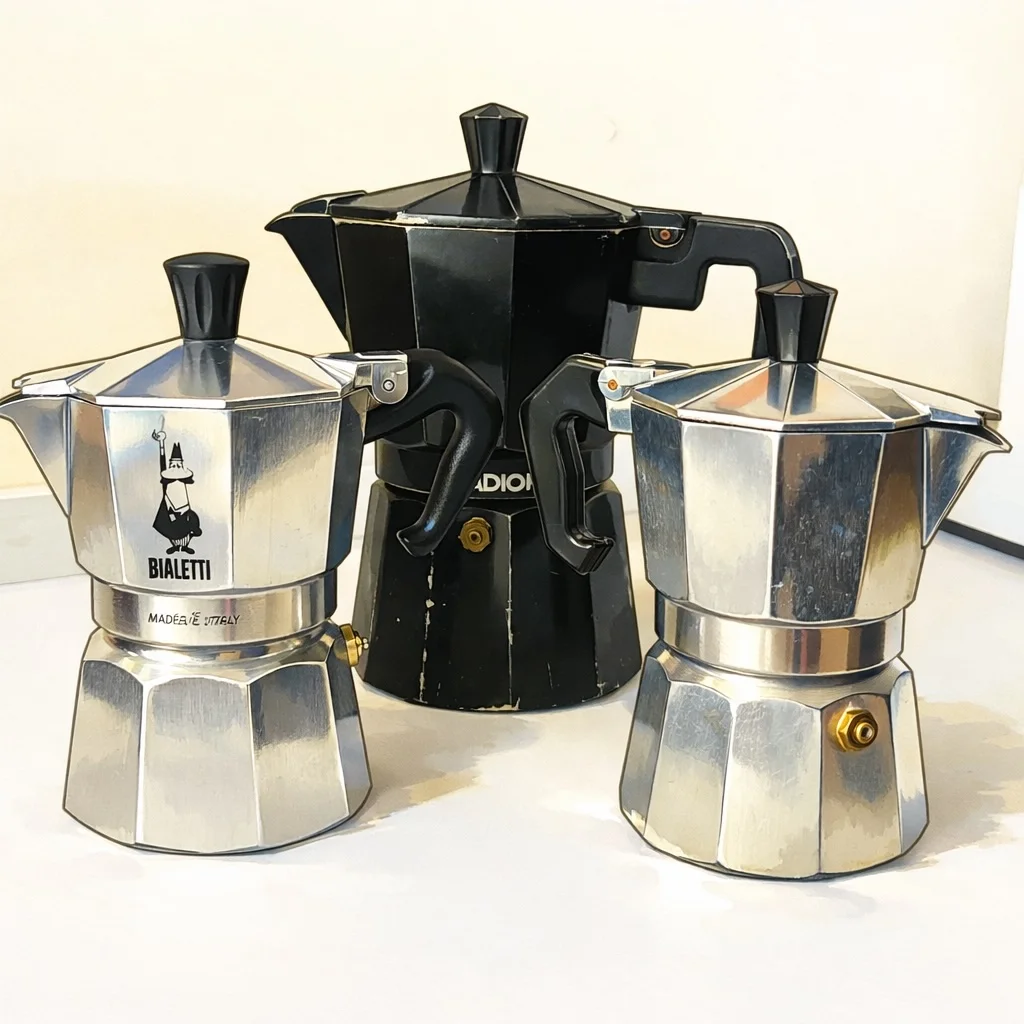
My first serious piece of coffee-brewing equipment (not counting the Nespresso - why a bit later) was a French press. While I still feel this simple and good-looking piece of equipment is great for brewing coffee overnight, my everyday go-to is the even better-looking Moka pot.
When I first learned about this aluminium, pressure-based coffee maker, I hurried into buying one without researching. No use denying it, it was GAS. Over the next few months I ended up buying two more, after using and learning a few interesting things about them. So here's a recap of my Moka pot journey.
The First - Agaro Classic Moka Pot
This was the first Moka pot I got - from BlinkIt. It was a 240ml one - 6cups. And because I didn't know better, and I thought the amount of coffee (the yield) from it was too little, I drank one potful of coffee twice every day for a few days. Take it from me, that much caffeine is not good for you. Now it sits in a sideboard shelf, waiting for the day when a bunch of coffee connoisseurs turn up. Cheap, at ₹650.
Generic 2 cup
As soon as I realised my mistake with the 6cup, I started looking for a 2cup version. I wasn't sure of Moka pots yet, and didn't want to spend a lot, so the one I ended up buying was a generic 2-cup Moka pot from Amazon. The page on the site lists it as a "3D Creations" brand, but the pot itself has no branding whatsoever. Probably several white-label brands on the site sell the same model. It works, that much I can say, and it was more expensive compared to the bigger Agaro, at ₹895. But at least now I was on the right path to having good coffee in non anxiety-inducing amounts.
Bialetti Moka Express (2Cups)
After a few months with the generic 2cup pot, I hit upon a snag. While trying to figure out the right way to use a Moka pot from a YouTube channel I frequent, I realised that the pot I had could not hold enough coffee. More on this below, but suffice to say I ended up buying the Bialetti. This is the traditional, and standard, Moka pot. Made in Italy, so it's got the coffee pedigree going for it. The company started back in 1933, and they are known as the 'inventors' of the Moka pot. It is the most expensive of the lot, at ₹2790. A decent part of this should be the import duties and what not, but the value still shows, in more ways than one. Let's see how.
I can only compare the Bialetti to the other 2cup pot I have.
Build Quality
While both the pots are aluminium, there is a significant difference in the build quality. The difference in heft (if you can call it that, for such a small thing) is evident. The Bialetti weighs in at ~325g to the ~180g of the generic 2 cup. That's substantial, and you can feel it. The added weight is also on the parts that matter - in the Bialetti, the lower chamber (the boiler) is almost twice as heavy at 150g as the generic pot's 80g boiler.
Basket Volume
Now, to be honest, coffee is not an exact science - there is no "right" strength of coffee. It is pretty subjective, so for this next part I won't call it right or wrong, but present a different opinion.
Moka pots are notorious for being almost one-dimensional about usage - the coffee basket should always be full without being heaped, the water in the boiler should be at most just under the valve. While people do adjust the amount of water in the boiler to get stronger/leaner coffee, the coffee basket itself is uncompromising - under-filling or overfilling the basket is not recommended. Thus, the yield and TDS of coffee out of a Moka pot is pretty deterministic, if all variables are kept the same. Bialetti being the inventors of the Moka pot, I look at their design as "standard" in all aspects.
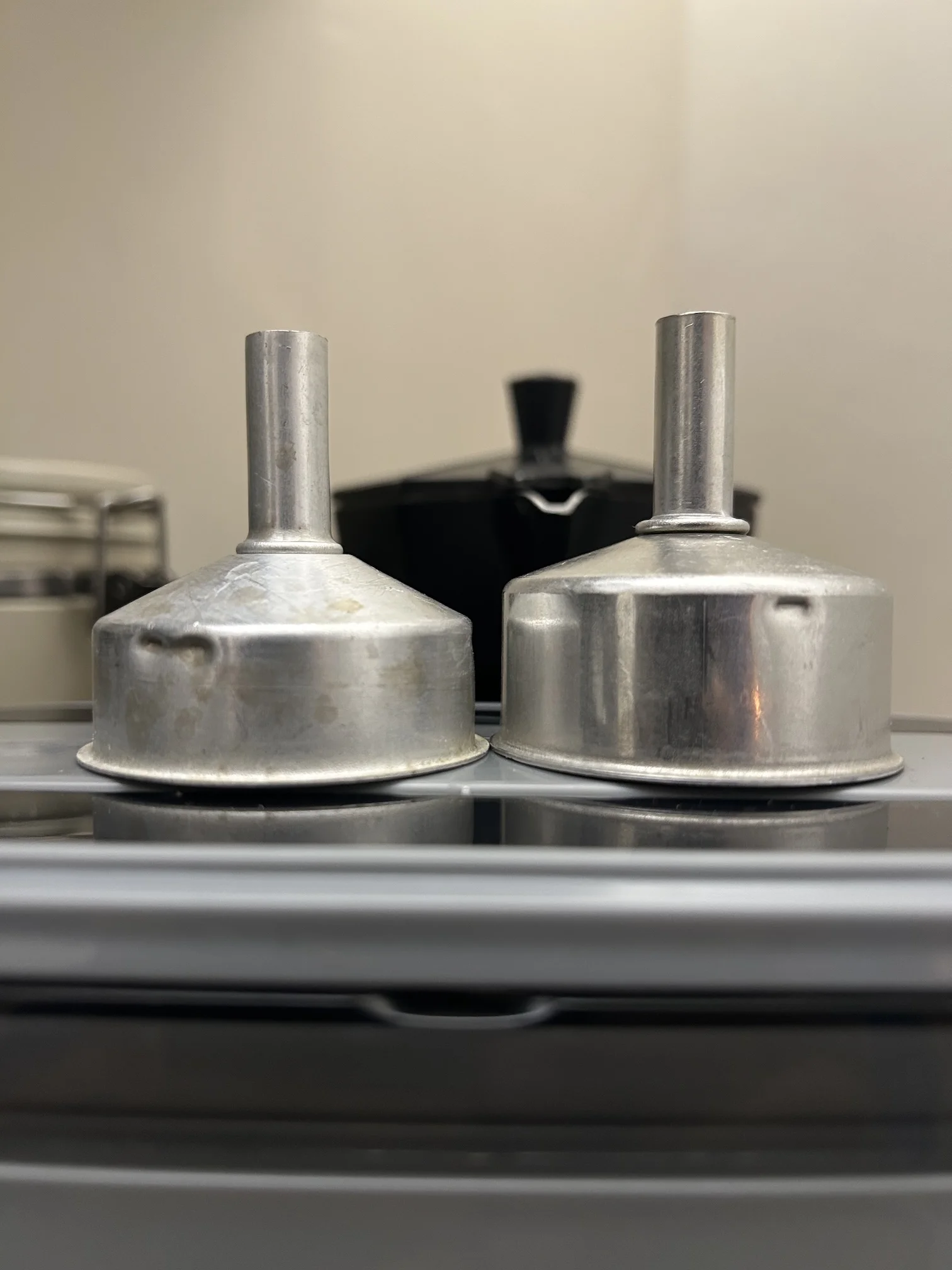
And here's where things get interesting. The Bialetti pot's coffee basket measures 4.5cm in diameter, and is 2cm deep, giving a volume of ~32cm3, while the generic 2 cup pot's basket has the same diameter, but is shallower at 1.5cm deep, giving a volume of ~24cm3. That's ~33% less volume than the Bialetti, and as a result it holds less coffee grounds.
The Filters
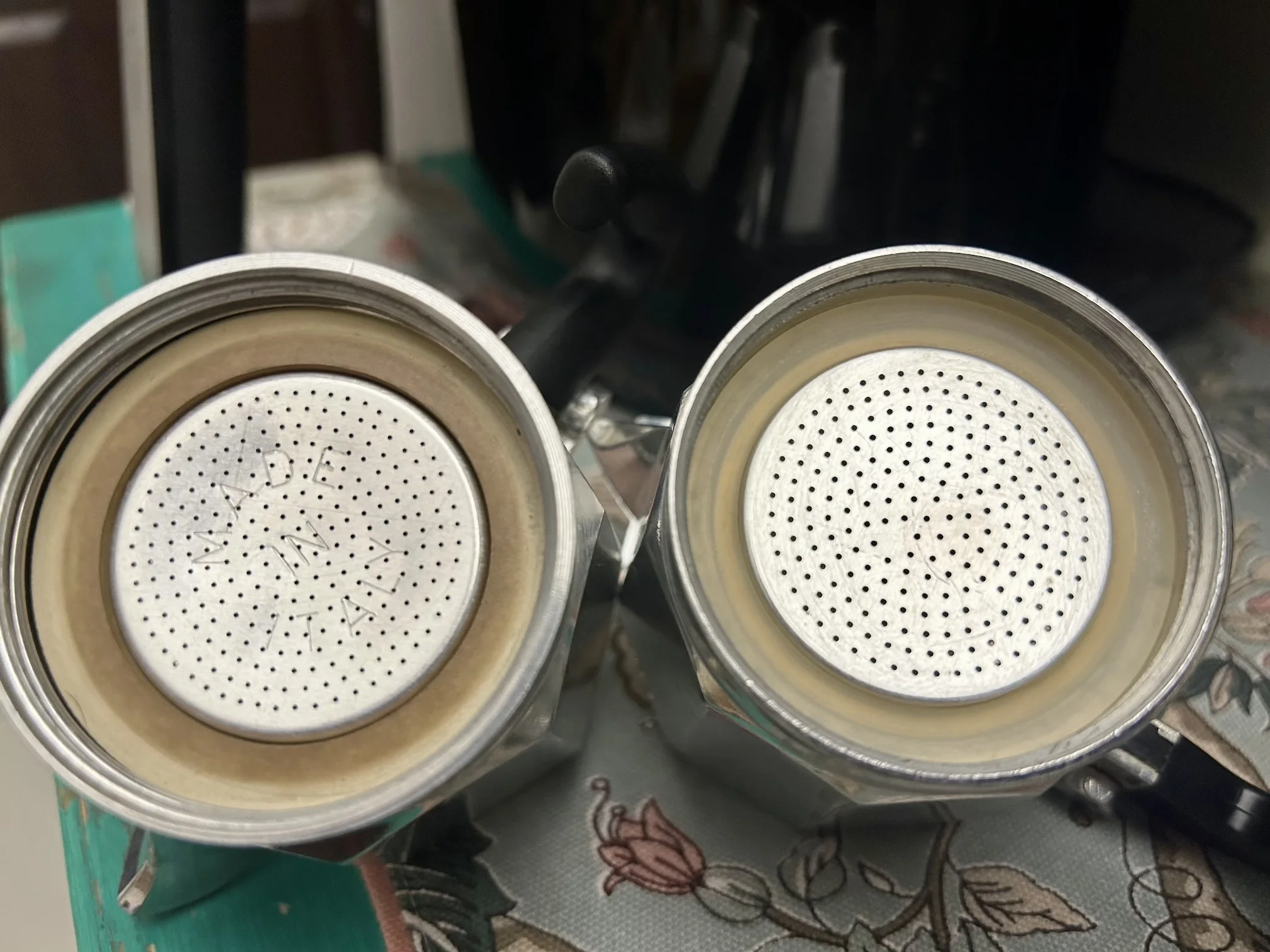
The image below shows the filters of the two Moka pots. There are two things that are immediately obvious:
- The Bialetti's filter has smaller holes
- The Bialetti's filter has more holes.
What it all means
- The generic pot's smaller basket holds ~8-9g of coffee, while the Bialetti holds 12g. So for the same amount of water, the Bialetti will produce stronger coffee.
- The smaller holes on the Bialetti filter
- Will theoretically create more resistance to the water passing through the coffee, which translates to more pressure, and thus better extracted coffee.
- Being more numerous, cover a larger surface area of the filter, so the extraction should also be more uniform over the cake.
- Prevent coffee grounds from being carried into the top chamber, creating a better overall experience.
So yes, in theory, the Bialetti should produce better coffee. But to be honest, till the time I noticed all these differences in the pots, I wasn't unhappy with the generic pot.
All these effects can also be mitigated in the generic pot using a filter paper, to an extent. But a filter paper may add its own set of variables to the mix, and affect the coffee in different ways.
My simple recommendation?
Go for the OG, the Bialetti. Because it is the gold-standard, and you know you are having coffee from equipment deliberately designed to brew coffee, and not from one whose sole intention is to be a cheap and not-thought-through imitation.